
The IRS has issued indexing adjustments for the applicable dollar amounts under Code Sec. 4980H(c)(1) and (b)(1), which are used to determine the employer shared responsibility payments (ESRP). This...
The IRS has updated its Conservation Easement website to expand guidance on abusive conservation easement transactions. In the announcement, the IRS stated that promoter-driven conservation easement...
The IRS has advised individual taxpayers that errors in a filed federal return may be corrected by submitting an amended return where key items affecting tax liability have changed. Amendments are gen...
The IRS has highlighted several digital tools and resources available to help small businesses and entrepreneurs manage their tax responsibilities during National Small Business Week. These tools are...
Effective July 1, 2026, through June 30, 2027, the oil spill prevention and administration (OSPA) fee is increased from $0.096 to $0.099 per barrel of crude oil, petroleum products, and renewable fuel...
Eliot Ullman is quoted in an article about the Earned Income Tax Credit that appeared on the Alert Investor web site on March 27, 2017.
Mar 27 2017 | By Phyllis Furman
What tax break has been around for more than four decades and could be worth more than $6,000 for qualified, modest-income workers?
If you said the Earned Income Tax Credit (EITC), pat yourself on the back. As many as one in five individuals eligible for this credit don’t know about it and fail to claim it, leaving billions of dollars on the table every year, according to the IRS.
“The EITC can supplement your earned income and can help you pay the bills,” such as rent and household expenses, said Eliot Ullman, a CPA with Miller Ward & Co.
The maximum credit for tax year 2016 is $6,269, though the actual amount an EITC-eligible taxpayer may receive depends on a number of factors, including your income, marital status and number of qualifying children.
Last year, some 26 million people received the EITC with an average credit received of about $2,400.
Want to learn more about the EITC? Read on.
How do I know if I qualify?
Just as its name implies, this credit is only for people who have earned income, meaning they work and get paid. Earned income includes earnings from working for someone else or earnings from being self-employed. The maximum amount you can earn, and be eligible, is $53,505.
In order to claim the credit, you must file a federal tax return and you must file as an individual or as married filing jointly. There are other eligibility rules, and they can get complicated. To see if you are eligible, check out the IRS’ EITC Assistant tool.
Even if you didn’t qualify last year, it’s worth checking again this year. About one third of the EITC eligible population changes every year, according to the IRS.
Do I have to have kids to qualify?
You can be married or single, with or without children to qualify. However, the number of children you have could influence your eligibility and how much you might be eligible to receive.
Generally speaking, the more children you have, the higher the potential credit.
For instance, the EITC credit ranges from $11 to $6,269 for those who have three or more qualifying children. But the range is $2 to $506 for someone with no qualifying children.
I heard the EITC is a refundable credit, what does that mean?
Unlike a tax deduction, which lowers your taxable income, a tax credit reduces the taxes you owe dollar for dollar. When a credit is refundable it means you might get this money, even if you don’t owe any taxes.
For example, if you owed no taxes and you qualified for a $1,000 EITC, you would receive the entire $1,000 as a refund.
What if I have investment income? Can I still claim the EITC?
Your investment income can’t exceed $3,400 for tax year 2016, in order to be eligible.
Where can I get free tax filing help?
The IRS’ Volunteer Income Tax Assistance, or VITA, program offers free help to qualifying taxpayers at thousands of sites across the country.
Are there other credits that are comparable to the EITC?
If you qualify for the federal EITC, you might also qualify for a comparable credit from your state or local government. Click here to see what states and local municipalities offer a similar credit.
I heard there were EITC refund delays this year, what’s that about?
Starting this year, a new law aimed at cutting down on tax return fraud requires the IRS to hold refunds for those claiming the EITC and another credit, the Additional Child Tax Credit (ACTC), until February 15.
This new law requires the IRS to hold your entire refund, even the part not associated with the EITC or the ACTC. You can use the IRS’ Where’s My Refund? tool to check the status of your refund.
Michael Eisenberg comments on uncertainty over the Affordable Care Act's health insurance coverage requirement and tax related penalty in the February 24, 2017 California Healthline syndicated column Ask Emily.


By Emily Bazar
February 24, 2017
K.A. Curtis gave up her career in the nonprofit world in 2008 to care for her ailing parents in Fresno, which also meant giving up her income.
She wasn’t able to afford health insurance as a result, and for each tax year since 2014, Curtis has applied for — and received — an exemption from the Affordable Care Act’s coverage requirement and the related tax penalty, she says.
This year, given President Donald Trump’s promise to repeal the ACA, along with his executive order urging federal officials to weaken parts of the law, Curtis began to wonder whether she’d even have to apply for an exemption for her 2016 taxes.
She also heard that the IRS recently flip-flopped on its previous decision to reject 2016 tax returns that don’t include the taxpayer’s health coverage status.
“I thought, ‘Maybe I won’t have to apply for the exemption again,’” says Curtis, 59. “The public debate about the law makes it confusing.”
Indeed, there’s widespread confusion among consumers about the status of Obamacare, and because of that, they are uncertain how to handle Obamacare-related tax requirements.
Michael Eisenberg, a CPA in Encino, acknowledges that there may be consumers who owe a penalty and are hoping that a repeal in the coming months would get them off the hook ... “Maybe there will be clarity by October, maybe there won’t be,” Eisenberg says. “You can take your chances, but what’s the likelihood the law would be repealed retroactively? I don’t think it’s that great." |
Should you still submit your 1095 tax forms that show when you were covered — or, if you purchased a plan from an exchange, the amount of tax credits you received? Should you apply for an exemption from the Obamacare coverage requirement?
If you were uninsured in 2016 and don’t qualify for an exemption, should you pay the Obamacare tax penalty?
“Unfortunately, there are a lot of myths floating around,” says Lawrence Pon, a certified public accountant (CPA) in Redwood City. “Some of my clients ask me, ‘Does the law still exist?’”
It sure does.
As a result, California tax experts have some relatively simple advice for confused taxpayers.
“Until Obamacare is no longer the law of the land, we don’t have much choice other than to continue under the current rules and regulations,” says Janet Krochman, a CPA in Costa Mesa.
Death, Taxes And Obamacare
This year’s tax filing deadline is April 18th.
And as many of you learned in the past few years, Obamacare and taxes are inextricably linked.
As part of filing your tax return, you need to prove you had health insurance, or pay a penalty, unless you qualify for one of the law’s exemptions.
If you bought coverage through a health insurance exchange such as Covered California and received federal tax credits, which are based on an estimate of your income, you must report whether your actual income varied from your estimate. Since most of you received tax credits in advance, if there’s a difference you may either owe or be owed money.
Many tax preparers say they’d rather not deal with the law’s arcane and complex requirements. But every single one I spoke with says they will continue doing so as long as former President Barack Obama’s health law exists.
“I tell everybody I want all of their forms. We’re going to document everything,” says Rebecca Neilson, a registered tax preparer in Sheridan, about 40 miles northeast of Sacramento. “I’m not going to change what I’m doing because the law might get changed.”
However, a recent IRS switch has fueled hopes among some consumers that the agency won’t enforce the Obamacare tax penalty for 2016.
On 1040 tax forms, taxpayers must check a box attesting that they had health care coverage, or enter their penalty amount if they didn’t.
For the first two tax years that Obamacare was in effect, the IRS accepted tax returns that didn’t include this information but often followed up with taxpayers to get it. For 2015, about 4.3 million taxpayers did not check the box, claim an exemption from coverage or pay a penalty, according to the IRS.
The IRS had said it would start rejecting those forms outright for the 2016 tax year — until Trump signed his executive order.
Citing the order, the agency now says it will continue to process tax forms that don’t include a taxpayer’s health coverage status. “This is similar to how we handled this in previous years,” says an IRS statement.
At the same time, the agency says it will continue to enforce the health law and may follow up with taxpayers who withhold their coverage information.
“Legislative provisions of the ACA law are still in force until changed by the Congress, and taxpayers remain required to follow the law and pay what they may owe,” the IRS statement says.
Mixed Signals
Andrew Porter, a CPA in Contra Costa County, believes that the agency “has just added to the confusion” with this change but that taxpayers shouldn’t be lulled into complacency.
“They have to enforce the law,” he says. “It’s exactly the same as last year.”
Though Porter doesn’t advise it, if you choose not to report your coverage on your tax return, he urges you to make sure you have your 1095 form so you have proof of coverage.
“If the IRS does come calling and says you owe this penalty, producing that document may be very useful,” he says.
Michael Eisenberg, a CPA in Encino, acknowledges that there may be consumers who owe a penalty and are hoping that a repeal in the coming months would get them off the hook.
They could request a tax-filing extension, allowing them to submit tax forms to the IRS in October, he says.
But that’s not a sure thing and would require any change in the law to be retroactive to the 2016 tax year, he says. If the penalty is not forgiven, they would have to pay it, plus interest.
“Maybe there will be clarity by October, maybe there won’t be,” Eisenberg says. “You can take your chances, but what’s the likelihood the law would be repealed retroactively? I don’t think it’s that great.”
Krochman, the Costa Mesa CPA, has a few clients who owed the penalty in previous years but haven’t paid it.
“They’re kicking the can down the road in the hopes there will be retroactive removal of the penalty once the law is repealed or replaced,” she says. “What happens down that road, we don’t know.”
Given the uncertainty, my biggest piece of advice is, and always has been, to consult with a tax professional. If you can’t afford it, multiple programs offer free tax help, including the Volunteer Income Tax Assistance (VITA) program, run by the IRS www.irs.gove/VITA and the AARP Foundation Tax-Aide program (www.aarp.org/findtaxhelp).
In the face of the confusion, Curtis, of Fresno, erred on the side of caution.
“I ended up deciding this year to go ahead and file the exemption paperwork and be safer than sorry,” she says. “It is the law, and we’re stuck navigating our way through it, as difficult as it may be."
Michael Eisenberg explains why it's important to keep your tax returns for a long time in this January 20, 2017 article by The Washington Post.


Experts recommended scanning documents to reduce your paper load. (Silvia Jansen/Silvia Janse
 By Michelle Singletary, Columnist / January 20, 2017
We are still a paper nation.
Despite technological advances, we continue to use a lot of paper. And a lot of it is stuffed in closets, file cabinets and shopping bags. And, for some of us, stacked on our floors.
Since Jan. 8, I’ve been encouraging people to participate in my #NoDebtNoMess Color of Money Challenge. It started with assessing the mess in your home and in your finances. The second week dealt with reducing redundancy, such as paying off and then closing credit card accounts you don’t need.
This week, we are focusing on lightening your load. For me, this means addressing the paper load I’m carrying. I have pay stubs from decades ago. I keep receipts and instruction manuals for items I no longer own. This paper has got to go.
To clean up your financial life, first assess the mess.
But to be sure I keep what I truly need, I asked some professionals for advice on what documents should be retained.
Let’s start with tax records. Brent Neiser, a certified financial planner and a senior director at the National Endowment for Financial Education, offered these guidelines:
- Keep tax records up to seven years after the return is filed.
- If you fail to file in any year, or if the IRS has found you filed something fraudulent, you’d better save your records indefinitely.
- Keep business, real estate and investment purchase records until seven years after you’ve sold the asset and included the sale in a tax return.
- Keep your tax returns indefinitely. A return is “a window into you and your family’s economic history,” Neiser said. “It shows the big employment, investment, charitable, spending choices and decisions you made.”
To cut down on clutter, cut up some of those credit cards.
Maintaining years of tax returns can help if you ever need to research payments made into Social Security, said Michael Eisenberg, a Los Angeles-based certified public accountant and member of the financial literacy commission for the American Institute of CPAs.
Save receipts for big-ticket items such as a TV or computer for insurance purposes. Hold on to each receipt as long as you own the item.
Don Grant, a CFP from Wichita, gave this advice regarding credit card statements: “It’s nice to see a monthly itemization, but most credit card companies will provide you with a year-end statement that has all expenses categorized. It you’re happy with that, shred [the monthly statements] at the end of the year.”
When it comes to home improvement documents, Kelley Long, a Chicago-based CPA and CFP, says hold on to them at least until you sell.
“If you sell your home for more than $250,000 ($500,000 for married people) more than you originally paid, you will have a taxable gain,” Long said. “You can add the cost of any improvements to the original amount you paid to reduce the amount of the gain.”
On medical bills, she said: “If you paid a medical expense with your health savings or flexible spending account, you need to keep the receipt for three years. Consider it a tax-related document.”
As for investment and real estate records, “there’s some gray area here,” said Long, who is part of AICPA’s consumer advocacy group. “But any investment statements that are available online do not need to also be kept as paper. The most important reason to maintain these records would be to establish your cost basis when selling to make sure you claim the proper capital gain or loss on your tax return.”
There are what Long referred to as “forever documents,” which you should keep in a safe location where they are protected from damage, loss and theft. Such documents, which may be hard or costly to replace, include:
- Birth certificates and adoption papers
- Marriage license and divorce documents
- Wills
- Death certificates
- Military records
- End-of-year pay stubs
- Mortgage, student and car-loan payoff statements. If you negotiated to pay less on a debt you owed, keep the document proving you paid off that loan.
The NEFE has a noncommercial financial education site where you can find more information about record keeping. Go to smartaboutmoney.org and search for “How Long Should You Keep Financial Documents.”
All the experts recommended scanning documents to reduce your paper load.
“I have instructed all of my clients to search for a place in the cloud that they feel comfortable storing all of these documents in a password-protected vault,” said Brad Ledwith, a CFP from Silicon Valley. “If they secure storage of files in the cloud, then the questions of how long to keep things are moot.”
Now that I know, I’m ready to let go.
Consider the recreational or educational activities available when deciding where to retire advises Michael Eisenberg in this January 9, 2017 article in the Journal of Accountancy.

Health care and activities, not just cost, are deciding factors in choosing a retirement destination.
By Ilana Polyak
January 9, 2017
There is no shortage of suggestions about where to retire, be it on a sunny beach or in a college town bustling with cultural and educational opportunities. But deciding where to live is a complicated calculation that must balance charm with affordability, community, and medical care.
Even so, CPAs say, many clients approach retirement without a clear plan about where they'll live.
Clients need plenty of time to consider all their options, and CPAs need time to run the numbers about all the possibilities under consideration. Our experts share their best ideas and what's involved in helping clients make a well-informed choice.
First up: housing
Many clients strive to cut expenses in order to stretch their retirement dollars. Therefore, it makes sense to "look at the most expensive budget items like housing first," said Jim Shambo, a CPA/ PFS who is retired from Lifetime Planning Concepts Inc. in Peyton, Colo.
By moving, retirees could substantially lower their costs. Consider that the average new home now clocks in at 2,400 square feet, much more than typical empty nesters need. Moving to small accommodations could help clients pull some equity out of their existing homes, while also reducing taxes, insurance, and upkeep.
"It makes sense to downsize," said Brooke Salvini, CPA/PFS and principal at Salvini Financial Planning in San Luis Obispo, Calif. "But it could actually cost more," if the move is into a thriving city center. If reduced housing costs is a goal, a long-distance move may be necessary. The median sale price of a home in the District of Columbia is $542,000. But in Florida it's just $197,000, and $217,000 in Arizona, according to the property listing website Trulia.
To slash costs further, a growing number of retirees are moving abroad. Nicaragua, Panama, and Ecuador are among the most affordable places for retirees to put down new roots, according to International Living magazine. Even with domestic help and dining out frequently, retirees could trim their monthly expenses to under $2,000. "Places like that have a large expatriate community where you can stretch the dollar and it could be quite fun," Salvini said. But the cost of traveling back to visit family and friends can be significant for retirees living abroad. Those expenses could eat into the potential savings of relocating.
Also, a less expensive locale—either stateside or overseas—can have hidden costs. In Florida, for example, retirees must consider the cost of hurricane insurance, Shambo said. In low-lying areas, flood insurance is crucial.
Follow your interests
Cost alone can't drive the decision about where to live, insisted Michael Eisenberg, CPA/PFS, managing partner of Innovative Wealth Advisors in Encino, California.
A retired client couple of his recently moved to Santa Fe, N.M. They wanted to lower their housing costs, which the move helped them accomplish. But because the wife was an artist, they were especially drawn to the artistic community the town boasts. "You want to make sure there are recreational or education activities wherever you go that you want to do," Eisenberg said.
For others, being close to family is paramount, and they want to be near their growing grandchildren no matter where they live. But bear in mind that this choice could increase living costs, Eisenberg noted. Young professionals are drawn to vibrant urban areas with career opportunities—but also high costs of living. On the other hand, retirees can benefit by receiving help from family, Eisenberg said. If the relationship between family members is a good one, a retiree may be able to rely on children and grandchildren instead of hiring a home health aide.
Tax considerations
Seven states—Alaska, Florida, Nevada, South Dakota, Texas, Washington, and Wyoming—levy no income tax at all, according to the Tax Foundation. That's a good starting point for retirees seeking to lower their expenses, said Jean-Luc Bourdon, CPA/PFS and principal at BrightPath Wealth Planning LLC in Santa Barbara, Calif. It's also important to compare tax brackets, he added. "Moving from a state where you pay a 10% income tax to a state where you pay none is compelling," Bourdon said. "Moving from a state where you pay 2% is not."
Furthermore, a retiree's tax burden is determined by his or her income mix. For some, pension and Social Security benefits make up the lion's share of income. Many states don't tax Social Security benefits, and some may even provide a tax break on retirement income.
Other retirees' income may derive primarily from dividends, and two states, New Hampshire and Tennessee, do tax interest and dividend income even though they don't tax most other types of income. "Those states that don't have an income tax logically have to make it up somehow," Bourdon said. "You have to know the entire tax picture."
There are also property taxes and sales taxes to consider. New Hampshire, though generally a low-tax state, has among the highest property taxes in the nation. Texans, while paying fewer taxes than residents of other states, are saddled with a steep state sales tax.
Pay attention to health care
No matter how enticing the beach or how hopping the restaurant scene is, it won't mean much if there aren't doctors nearby. Moving may be out of the question for clients who suffer from chronic conditions and require a big team of specialists.
Access to health care, Shambo said, is something retirees must keep in mind. A move to a rural area may bring clients the quiet they crave, but what happens when there's a major health event and it takes more than an hour to get to a health care facility? And for those who live overseas, there are other complications. "Medicare does not cover out-of-country costs," Shambo noted. What's more, some locations may have substandard care, leaving retirees with the dilemma of whether to be treated locally or return to the U.S. On the other hand, places like Colombia and Malaysia have high-quality healthcare that's affordable by U.S. standards, according to International Living magazine.
There is no one best place to retire. That decision is as individual as clients themselves. However, by understanding what's important to clients, CPAs can guide them to their ideal retirement spot.
Ilana Polyak is a freelance writer based in Northampton, Mass.
Michael Eisenberg offers advice on harvesting your losses in this December 20, 2016 article published by American Funds.

Five Year-End Tax Tips for Investors
Your Year-End Tax To-Do List
As the end of the year approaches, you might be thinking about the holidays, gift giving and the festivities ahead. But now’s also the time to focus on some important tasks that could bring you some joy — or at least lower your pain — at tax time.
There are steps you can take before December 31 that might improve the tax efficiency of your investment portfolio. While you shouldn’t let tax considerations drive your investing decisions, here are some tax tips to think about:
Tax Tip 1: Get Smart About Annual Mutual Fund Distributions
It’s relatively easy for investors to comprehend the idea that they might owe capital gains tax if they bought a stock and sold it at a profit. But some are surprised to learn they might owe taxes on a mutual fund investment even if they didn’t sell that fund.
Why the tax hit? When a mutual fund sells a security at a profit, that sale creates a capital gain. By law, that gain must be distributed to a mutual fund’s shareholders. Assuming you’re holding that fund in a taxable account, that gain is taxable.
Here’s the good news: knowledge is power. Fund companies generally publish information on expected capital gains distributions in November or December. This information will give you a sense of how big that distribution might be and what you might ultimately owe in taxes in April as a result.
In general, “it’s always a good idea to do a tax projection in November and December so you won’t have surprises when you do your return,” said Barry Picker, a CPA with Picker & Auerbach. “Find out as soon as possible what your capital gains distribution will be.”
Having this information might trigger some action on your part. If you’re thinking about purchasing a particular mutual fund, you might wait until after the distribution is made. Conversely, you might consider selling a fund before the fund makes a distribution.
Keep in mind, however, there may be costs associated with selling that fund, such as paying capital gains on the sale of your fund shares. And you might have seller’s remorse if that fund were to go up in value after you sold.
Tax Tip 2: Harvest Your Losses
At a certain point it might be time to sell an underperforming asset. The argument becomes even more compelling if you’ve had capital gains over the course of the year.
Capital losses can be used to reduce capital gains, dollar for dollar. In addition, in any given year, if your capital losses exceed your capital gains, you can use up to $3,000 of capital losses to offset other kinds of income. The remainder of the loss can be carried forward to offset your income in future years.
“We had a client who earlier this year had a rental duplex and sold it,” said Michael Eisenberg, a CPA, and a member of the American Institute of CPAs’ (AICPA) National CPA Financial Literacy Commission. “We talked about what he could sell in his portfolio to offset some of the gains.”
It’s important to remember the IRS’ “wash sale” rule, which prohibits you from claiming a loss if you sell a security and then buy a “substantially identical” security within the 61-day period starting 30 days before the sale and ending 30 days after the sale.
However, you might be able to buy a similar mutual fund and not trigger the wash sale rule. “You can’t sell a fund one day and immediately buy that fund,” Eisenberg said. “But you might be able to buy one with similar holdings.”
Harvesting losses could be especially helpful to higher income investors who face higher capital gains rates, as well as the Net Investment Income Tax (NIIT).
The NIIT, which went into effect in January 2013, adds a 3.8 percent tax to certain net investments — such as dividends, interest and capital gains — for individuals, estates and trusts that have income above certain thresholds.
Tax Tip 3: Consider a Roth Conversion
The deadline for converting some or all of your traditional IRA into a Roth IRA is December 31. Why consider this year-end tax tip? Generally this move makes sense if you believe you’ll be in a higher tax bracket when you retire.
With a traditional IRA, contributions may be tax deductible in the year you make contributions, while withdrawals are taxed as ordinary income. With a Roth IRA, your contributions are not tax deductible, but qualified withdrawals are tax free.
You’ll have to pay income tax on the amount you convert, and the additional income could put you in a higher tax bracket. But if you change your mind after you convert to a Roth, you have an out: You can re-characterize — undo — a 2016 IRA conversion until October 15, 2017.
Tax Tip 4: Max Out Your 401(k)
Here’s a tax tip to remember all year round, but especially as the year comes to a close: Contributions to employer-sponsored retirement accounts, such as a 401(k) or a 403(b), reduce your taxable income — and you might receive a company match to boot.
For 2016, the maximum amount you can contribute to an employer-sponsored defined contribution plan is $18,000 and the catch-up contribution limit for employees 50 and above is $6,000. The deadline for 2016 contributions is December 31.
Tax Tip 5: Get Charitable With Your Investments
Consider taking an investment that’s appreciated in value and donating it to a charity.
“As long as you held the asset for more than one year…, you get a deduction for the current value — and you don’t pay tax on the appreciation,” Picker said.
In other words, you can do good for others and do well for yourself tax-wise. Now that’s a tax tip that could bring you joy as the year comes to a close — and far beyond.
Michael Eisenberg offers insight on the current rise in the personal financial satisfaction level in this October 27, 2016 article from the Journal of Accountancy.
Americans see highest level of personal financial satisfaction since 2007
By Samiha Khanna / October 27,2016
Americans’ personal financial standing continues to rise, according to the Personal Financial Satisfaction Index (PFSi).
A third-quarter analysis released Oct. 27 reports a net index value of 19.0. This represents the highest standing for the PFSi since the first quarter of 2007, when prerecession home values and job opportunities contributed to a net value of 19.1. The third-quarter figures represent a 1.7-point increase from the previous quarter and a 3.3-point increase compared with the same period last year.
The index offers perspective at a time of political uncertainty, said Kelley Long, CPA/PFS, a member of the AICPA’s Consumer Financial Education Advocates group. It suggests that many consumers have indeed recovered their personal financial standing since the recession, she said.
“The index gives consumers permission to feel satisfied about their situation when times are objectively good, instead of always worrying about what’s wrong,” said Long.
The PFSi is a proprietary measure of the financial well-being of the average American, assessed quarterly by the AICPA. It is calculated as the difference between two subindexes: the Personal Financial Pleasure Index and the Personal Financial Pain Index.
The Pleasure Index uses four equally weighted indicators to measure the growth of assets and opportunities: job openings; home equity; the PFS 750 Market Index, a proprietary stock market index; and the CPA Outlook Index, a measure of CPA executives’ sentiment of their companies’ economic prospects.
The Personal Financial Pain Index measures four equally weighted factors that suggest economic decline: inflation, personal taxes, underemployment, and loan delinquencies.
This quarter’s improvements in the PFSi value can be attributed largely to an increase in all four of the Pleasure Index indicators, including a 2-point gain in the PFS 750 Market Index, a 1.3-point gain in home equity, and a 0.9-point boost in the CPA Outlook Index.
The increase in home equity is the natural result of the rebound of the housing market, Long said. It means that many families may be able to refinance loans they could previously not afford.
Loan delinquencies are down 3.4 points from last quarter. However, underemployment held steady, remaining at 20% behind the average value before the recession, which continues to contribute to personal financial stress. Americans saw minimal gains in job openings per capita last quarter with a 0.3-point increase in job openings, largely in professional and business services and durable goods manufacturing.
“The PFSi shows that Americans’ financial satisfaction is back at prerecession levels, which is great news. However, the slow climb to get there has been frustrating for people who are looking for work and may still be underwater with their mortgage,” Michael Eisenberg, CPA/PFS, a member of AICPA’s National CPA Financial Literacy Commission, said in a press release. “While there have been substantial improvements in the job market, many of the industries and regions hit the hardest are not back to their 2007 levels.”
More information about the PFSi is available at aicpa.org/PFSi.
— Samiha Khanna is a Durham, N.C.-based freelance writer. To comment on this article, contact editorial director.
Why not use social media to garner envy over how you've accomplished a financial milestone rather than just posting photos of your latest vacation? Michael Eisenberg suggests a different outlook on using social media in a September 1, 2016 article by the AICPA.

You Fancy, Huh? One in Four Americans Envious on Social Media
Posted by James Schiavone on Sep 02, 2016
In these waning days of summer, my Instagram feed looks like a Lonely Planet top 10 list. I don’t know how, but it seems like the 300+ people I’m following have all conspired to be someplace awesome, while I’m toiling away in the office. It can feel frustrating when it seems like everyone (except for you) is having the time of their lives – and bragging about it online
A new survey, conducted by Harris Poll on behalf of the AICPA, found that when it comes to feeling envious on social media, I’m far from alone. In fact, many Americans are caught in a cycle of feeling jealous of friends who post about their lavish vacations and extravagant purchases, while admitting that they also post things solely because they are fancy or expensive.
Almost half of all Americans (47 percent) with social media accounts have posted photos of their vacation in the past year – which is a lot of shots of “hot dog legs” on tropical beaches for people to take in while they’re going about their daily life. And so, it’s no wonder that almost four in 10 U.S. adults with a social media account (39 percent) say that seeing other people’s purchases and vacations online makes them look into a similar purchase or vacation. And more than one in 10 of these U.S. adults (11 percent) are acting upon their interest and have taken a vacation or made a purchase in the last year after seeing someone’s post.
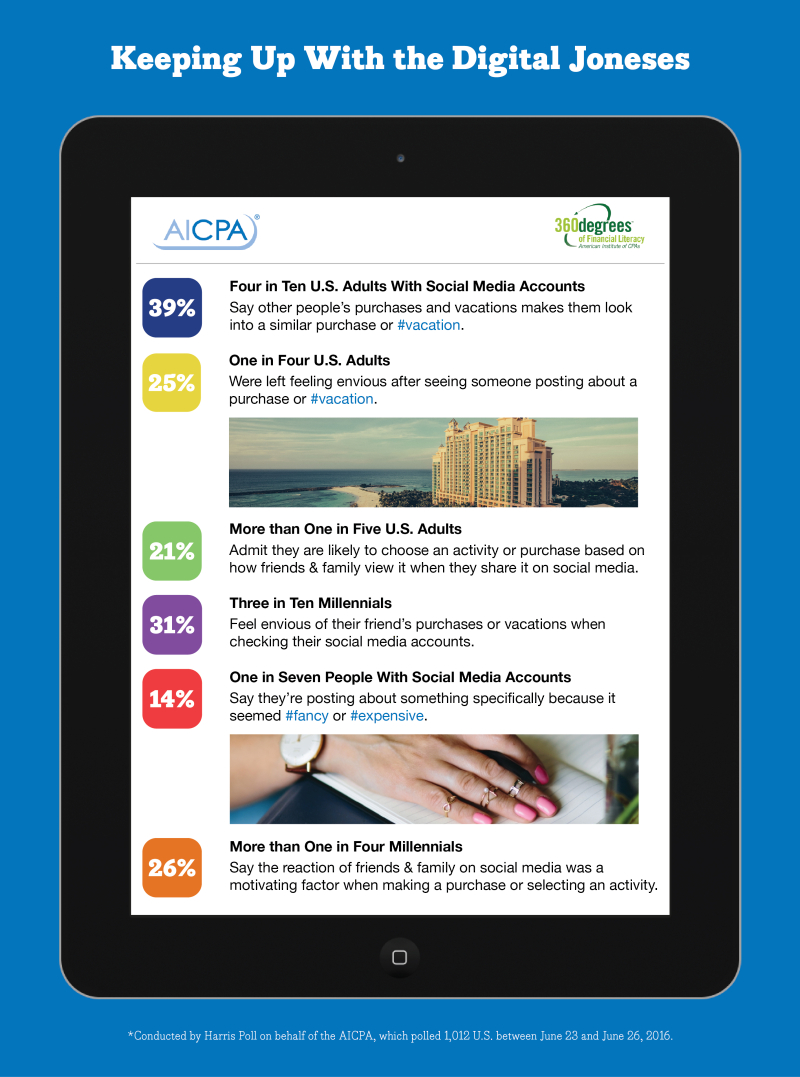
However, there is a fine line between interest and envy, and social media tends to make people feel the latter. One in four U.S. adults with a social media account (25 percent) were left feeling jealous after seeing someone’s post about a purchase or vacation online in the past year. Those feelings of envy may be causing people to make financial mistakes in an effort to keep up with the Joneses.
“Feeling envious on social media can certainly put pressure on individuals to try and live beyond their means, either from pictures of celebrities posting about their lifestyle, or even from peers posting about their most recent purchase, vacation or day trip,” said Dr. Sean Stein Smith, CPA, a member of AICPA’s National Financial Literacy Commission. “After all, everyone wants to have the good things in life, and the onslaught of social media posts has the potential to make this desire to spend money exponentially more powerful.”
In fact, more than one in five U.S. adults with social media accounts (21 percent) admit they are likely to choose an activity or make a purchase based on how their friends and family will view it when they share it on these social media platforms. And when people are making these financial decisions to help craft an image online, there’s a good chance it’s an upscale one. The survey found that 14 percent of Americans with social media accounts say they’ve posted about something specifically because it seemed fancy or expensive.
However, if you happen to find yourself caught up in a group of friends who have a bigger budget than you, there are ways you can work to keep the friendship alive without living beyond your means or making them feel like you don’t ever want to hang out.
“You can educate your friends as to your opinions on savings vs. spending and give them a reasonable picture of your finances,” says Michael Eisenberg, CPA/PFS, and a member of the AICPA National Financial Literacy Commission. “You may not have been able to take a group vacation this summer, but make sure your friends are aware that you want to know about the next trip, so you have time to save in advance and not go into debt paying for it.”
Eisenberg also recommends that people can get peer approval online by posting about reaching financial milestones, and maybe encourage greater financial literacy in their friends at the same time.
“While I would caution against sharing too much about your finances in a public setting, if you’ve reached a milestone like paying off your student loans, you can definitely post on your social media account about it,” said Eisenberg. “It’s positive reinforcement for your friends and followers. It lets them know that paying down debt is possible, if you prioritize. And people who care about you will genuinely be proud. Paying off your loans demonstrates financial sacrifice in a way that posting pictures of yourself in Hawaii doesn’t really convey.”
That said, as long as you’re keeping your eyes on the financial prize there isn’t anything inherently wrong with showing your friends you’re having a good time on social media. In fact, it may even help keep you in the habit of saving.
“Splurging every once in a while on a vacation or new purchase is healthy and an excellent way to reward your long term discipline,” said Dr. Smith.
Although social media could cause you to spend more than may be wise, there are new apps that can use the power of peer pressure to your advantage. In addition, the AICPA has a number of social media accounts that can help you make better financial decisions. To learn more, see the social media page for AICPA’s financial literacy initiatives.
James Schiavone, Senior Manager - Public Relations, American Institute of CPAs
This article from the September 1, 2016 Los Angeles Times reveals how most high school and college students are woefully unprepared to handle financial tasks such as saving, budgeting, managing credit or investing.


ON THE RECORD
Why students can’t bank on financial literacy
By James F. Peltz
SEPTEMBER 1, 2016
Even as many young people are about to start their first jobs or head to college with the prospect of enormous student loans, some often don’t know basic money skills.
Those include understanding the differences between checking and savings accounts, the terms of a credit card or the finances of buying a car, to name just a few topics.
Courses explaining personal finance often aren’t part of a high school curriculum; so many students have to look elsewhere — mainly at home — for answers.
Loyola Marymount University in Los Angeles is trying to help, offering financial literacy “boot camps” for high school students.
David Choi is director of the school’s Center for Entrepreneurship and Ron Rishagen is an entrepreneur in residence at the university. Both are involved in the boot camps, and we asked them to walk us through the problem. Here’s an edited excerpt:
What grade would you give high school seniors for their knowledge of basic money matters, such as how to write a check or how banks sometimes put a hold on a deposited check?
Choi: Probably a C-minus. More important than those mechanics is their understanding of the value of money and the idea of budgeting and not overspending. There’s also the sense of delayed gratification and not spending all you’ve got but saving for a better tomorrow. That kind of mind-set is where they really lag. On that, the grade would be even worse.
Why is there a lack of understanding?
Choi: There’s no place in the child’s development and through their education where they get any kind of lessons on money. At home, you have a couple of extra hours a day, and the students do their homework or study for the SAT or practice baseball. It doesn’t take a lot of time [for money matters] but there isn’t time in the kids’ schedule to fit that in.
What about learning these things in school?
Rishagen: I taught at a high school for 12 years. It’s really a travesty that educators have not made a requirement for financial literacy to be on the curriculum. Why do we learn how to calculate the area of a triangle in high school but not the power of compound interest?
What if financial literacy was taught in the public schools? How would that affect the poverty level or the crime level?
The parents are lacking in this kind of knowledge as well. We have had requests from parents if they could sit in on the workshops.
Choi: The lack of financial literacy is not just K through 12. I think most college students by the time they graduate probably know little about financial money matters.
Other than the mechanics of money, what else must students know about personal finance?
Rishagen: They need to save more than they spend. They need to invest early and frequently. They need to pay off any debt they have and use credit sparingly. They need to build assets. And they need to learn how to create passive income, say interest from certificates of deposits or other savings accounts.
At each of these workshops we’ve had, we started off asking the students if they want to be financially successful. You get 100% show of hands. Then the last question I ask is how many of you have had financial education in your schooling? Zero hands go up.
High school seniors often are looking at obtaining a credit card; do they have enough basic knowledge about credit cards?
Rishagen: They have the mind-set that a credit card is free money for them, not realizing [there are] interest charges and that if they don’t pay on a timely basis, their credit scores are going to be affected.
How hard is it to get across the idea of delayed gratification to a high school student?
Rishagen: It’s kind of a tough sell because they’re 17 or 18, and they don’t look past next week. We try to tell them that if they start now, their money can grow substantially through the power of compound interest.
Have advancements in banking, such as debit cards, changed how young people think about money?
Choi: It has made spending money easier, so I think the importance of self-control and learning about budgeting is even more important.
Rishagen: We encourage the use of debit cards because that helps track their spending, which in turn helps them develop and control their budget. We try to instill the discipline that if they’re on a budget, they should stick to that budget and not just have short-term gratification.
Our students are required to prepare a budget of their own. In one semester, I probably kicked back 90% of the budgets because they were incorrect. For instance, they thought their gross income is what goes into the bank and didn’t take into consideration all the deductions [such as taxes]. They were overstating their budget.
Choi: Even at the college level, I think most kids have never budgeted.
What’s the students’ reaction in your workshops? Personal finance can be pretty boring for a high school student.
Rishagen: Their reaction overall is very positive because we don’t just stand there and lecture. They work in groups on various projects.
In one case, we gave them a budget for lunch. They were required to buy four different things — an entrée, a side, a drink and a dessert — and they couldn’t go over $15 and couldn’t go below $10. That kind of activity gets them stimulated and they learn how to budget their food expenses.
Another of our objectives with the workshops is for the students to “save it forward,” where they can go home and instruct their friends, siblings, even their parents and make [the education] a domino effect. james.peltz@latimes.com Twitter: @PeltzLATimes
While the Personal Financial Satisfaction Index (PFSi) is up, Michael Eisenberg is cautious of political instability in a July 28, 2016 article published in the Journal of Accountancy.
By Courtney L. Vien
July 28, 2016
The second quarter of 2016 has seen its share of disruptive political events, including the contentious U.S. presidential race and the Brexit referendum, which led the Dow to briefly plummet by 900 points.
Nevertheless, Americans’ financial outlook remains positive, according to a proprietary AICPA measure. This quarter, the Personal Financial Satisfaction Index (PFSi) reached its highest levels since the third quarter of 2007.
The PFSi now stands at 17.1, up 3.4 points from last quarter and 1.2 points from this time last year. It was buoyed by a 5-point rise in the AICPA CPA Outlook Index, a measure of CPA executives’ sentiment toward their organizations’ economic performance. The PFSi received a further boost from rises in job openings and home equity, and a drop in loan delinquencies.
The PFSi reflects investors’ optimism, said Kelley Long, CPA/PFS, a member of the AICPA’s National CPA Financial Literacy Commission.
“Low mortgage rates combined with great job opportunities are giving people confidence to make some moves that maybe they’ve been putting off,” she said in a news release, “and this is a great sign for continued economic prosperity.”
However, geopolitical instability may shake Americans’ confidence in the economy further down the road, said Michael Eisenberg, CPA/PFS, another member of the AICPA’s National CPA Financial Literacy Commission.
“Individuals are working and have low interest rates. Home prices are up, investments are up,” he said. “That’s the good news. But it’s offset by the geopolitical news.” The impact of the presidential election on economic sentiment, he said, is difficult to predict—no matter which candidate wins.
Likewise, Eisenberg said, it’s still too early to tell how the Brexit referendum will affect U.S. economic outlook. Though the U.S. stock market rebounded quickly from the shock of the Brexit vote, the economy may yet experience some repercussions, he said.
“Brexit is a work in progress,” he said. “It could still lead to financial impacts that could have a trickle-over effect on the U.S. economy.” In a news release, Eisenberg observed that “many big financial companies may cut their hiring plans” in Brexit’s wake.
Furthermore, as the Brexit vote occurred late in the quarter, the PFSi may not have captured its full impact.
The PFSi is calculated as the difference between two subindexes, the Personal Financial Pleasure Index and the Personal Financial Pain Index. The Pleasure Index consists of four equally weighted factors: the AICPA CPA Outlook Index, a measure of CPA executives’ sentiment toward their companies’ economic futures; the PFS 750 Market Index, a proprietary stock index; home equity per capita; and job openings. The Pain Index also comprises four equally weighted factors: inflation, personal taxes, loan delinquencies, and underemployment.
The Pleasure Index rose 2.1 points this quarter. Job openings and home equity both increased by 2 points. The Pain Index dropped 1.3 points this quarter, partly due to a 4-point drop in loan delinquencies. Inflation was down by 1 point this quarter, while personal taxes and underemployment remained static.
Eisenberg said he counsels clients to focus more on their personal financial situation than on what’s happening in the world at large. “Spend less time worrying about what you can’t control,” he said. “You can make better decisions based on the small picture.”
—Courtney L. Vien (cvien@aicpa.org) is an associate editor for the AICPA.
Michael Eisenberg and Innovative Wealth Advisors are quoted in this June 28, 2016 U.S. News & World Report article on how to baby step your way to savings.
Baby step your way to savings

Low on savings? Set up automatic transfers from your checking account to a savings account.

By Geoff Williams June 28, 2016, at 2:53 p.m.
You've seen the numbers. They aren’t pretty.
A recent Bankrate.com survey of 1,000 adults suggests that 66 million American adults have zero dollars saved for an emergency. That dovetails nicely with a report that came out earlier this year from the Federal Reserve, which looked at the economic well-being of American households. And things are not going so well. About one-third of 5,695 respondents to a 2015 survey revealed they would have trouble dealing with a $400 emergency.
Sound familiar? Start building your savings with some of these methods.
Start small. That's advice from Mackey McNeill, founder and president of Mackey Advisors, a wealth management firm in Bellevue, Kentucky.
"If you have never saved anything in your life, save $5 a week or $10 a week," McNeill says, adding: "Pick a number that, regardless of disaster, you can achieve."
After you do that, McNeill advises, "Put the money in a separate account and review it once a month. After three months, consider an increase. After three more months, consider an increase again," and keep repeating.
"The reason people fail at saving is they start too high. ... So they set themselves up for failure," she says. "Start small. You will be so excited that you met your goal, you will automatically want to do more and achieve more. When you start small, you set yourself up for success. Success begets success. I have never had anyone try this who did not succeed."
Reward yourself when you save money. This is important, McNeill says, advising that whatever the reward be, make it something free.
For instance: If you save $10 a week, then every time you hit $40 saved, rent a movie at the library or take a walk in the park, she explains.
Whatever you do, "make it something that really nurtures you," she says. "It doesn't matter what it is. A hot bath will work. But when you give yourself the reward, you are reinforcing the behavior you want."
Trim back your expenses. One thing that probably keeps most people from saving more is that there may not be enough money to go around. That's definitely the case if there are expenses that could be easily cut, or debt that's weighing you down.
"When talking with clients that are beginning to put together a plan to save money, or begin their accumulation phase, the first thing I advise them to do is pay off any high-interest debt like credit cards," says Dan Milan, managing partner of Cornerstone Financial Services LLC, a wealth management firm in Birmingham, Michigan.
"Paying off high-interest debt is the most important first step in beginning any accumulation phase," he says. "I consider this part of a savings plan because everything you pay off, you are eventually saving money on high interest."
Make it easy. Assuming you have a bank – a Federal Deposit Insurance Corporation study suggests that 9 million Americans don't – the easiest way to save money is to set up a savings account and then direct a specific amount to go regularly from your checking account to your savings account, says Michael Eisenberg, a certified public accountant and personal financial specialist with Innovative Wealth Advisors in Encino, California.
"Every time your paycheck hits your checking account, you should instruct your bank to move a set sum directly into your savings account," he says. "This makes it easy and seamless."
Eventually, he says, you won't even miss the money because it's automatically disappearing, and you'll get used to working with the money going into your checking account.
Susan Howe, a certified public accountant in Philadelphia, echoes that advice. "Even a modest amount will add up quickly if you set it for a weekly transfer. Just be sure there are no fees," she says.
Try opening a 401(k) or an IRA. That's what Leonard Wright, a wealth management advisor in San Diego, suggests. In particular, Wright recommends opening up a Roth 401(k) or a Roth IRA
"This money grows tax-free for life, is not subject to required minimum distributions when you retire and best of all, is tax-free when you need it – and can help with education expenses for your children," he says.
The only downside? Some 401(k) s and IRAs require you to have some money to start the account, like a minimum deposit of $1,000, and if you have saved zero dollars, that may be a tough hurdle. But not every 401(k) and IRA has a minimum deposit – or some will waive that if you commit to paying a certain amount of money a month – so look around.
You also may want to check out myRA, a retirement savings account from the United States Department of the Treasury. It was designed for people who have had trouble saving money and for people who don't work for an employer that offers a vehicle for saving for retirement. It has no fees, and you can open a myRA for as little as $25.
But McNeill notes that wherever you put your money, whether in a 401(k) or other savings account, "in the beginning, it's irrelevant," – as long as you're saving money somewhere. "What you are trying to do is create a new habit."
Here's an overview of the economic issues surrounding the Brexit, and what this historic decision could mean for the United Kingdom, world trade, and international investors.
 On June 23, citizens of the United Kingdom (England, Scotland, Wales, and Northern Ireland) voted to leave the European Union by a margin of 52% to 48%.1 Though pre-election polls suggested that public opinion was evenly divided, when the election results became clear, financial markets around the world reacted swiftly to concerns about potential economic ramifications of a British exit—or Brexit—from the EU.
On June 24, the British pound plunged more than 10% against the dollar to its lowest point since 1985, before recovering slightly to settle nearly 8% lower at the end of the day.2 European stocks suffered the worst sell-off since 2008, with the Stoxx Europe 600 Index tumbling 7%, and the Japanese Nikkei Index posted a one-day drop of 7.9%.3–4 In the United States, the S&P 500 Index fell 3.6%, reversing year-to-date gains.5
Here's an overview of the economic issues surrounding the Brexit, and what this historic decision could mean for the United Kingdom, world trade, and international investors.
The EU and the Referendum
The European Union was formed after World War II to help promote peace through economic cooperation. Over time, it became a common market, allowing goods and people to move freely around 28 member states as if they were one country. The U.K. joined the trading bloc in 1973, when there were only 9 member states.
In 2012, Prime Minister David Cameron rejected calls for a referendum on EU membership but later agreed to hold one if the Conservative party won the 2015 election.6 The leaders of all five major political parties campaigned to remain in the EU, including Cameron, warning voters that leaving the EU was a leap into the unknown that could damage the U.K.'s economy and weaken national security.7
Brexit supporters said leaving the EU allows the nation to take back control over business, labor, and immigration regulations and policies. They also claimed the money being contributed to the EU budget (a net contribution of 9.8 billion pounds in 2014) would be better spent on infrastructure and public services in the U.K.8
Economic Expectations
The negative outlook for the U.K. economy depends on the terms of trade deals yet to be negotiated with the EU and other nations. For example, the International Monetary Fund (IMF) projects that U.K. gross domestic product could decline about 1.5% by 2021, assuming the United Kingdom is granted access to the EU market quickly. Under a more adverse scenario (which assumes trade defaults to World Trade Organization rules), the IMF projects a precarious decline in GDP of about 4.5%.9
The U.K.'s departure strikes a serious blow to the EU, which has been beleaguered by debt crises, a Greek bailout, the influx of millions of refugees, high unemployment, and weak GDP growth. If trade activity and business conditions in the region deteriorate, it's possible that the U.K. and the EU could fall back into recession.
Next Steps
Once Article 50 of the Lisbon Treaty is invoked, the formal process of leaving the EU will begin, opening up a two-year window of negotiations on the terms of the exit. The U.K. will remain a member of the EU until it officially departs.10
The U.K. is the first nation to break away from the EU, but a larger concern is that anti-EU factions in other nations could be empowered to follow suit. Moreover, Scotland could seek independence from the U.K. in order to remain in the EU, and Northern Ireland might consider reunification with the Republic of Ireland.11
What About Us?
The EU is the largest trading partner of the United States, so the Brexit complicates pending trade negotiations and will require adjustments to existing agreements. It may also take time to forge new deals with the U.K.12
U.S. companies with a significant presence in the U.K. could take a hit. With the British pound weakening against an already strong dollar, U.S. exports become more expensive, reducing foreign sales. The U.S. economy is not as vulnerable as the EU, but the U.S. Federal Reserve may be more likely to delay its decision to raise interest rates until the consequences of the Brexit on U.S. and global markets can be assessed.13
Brexit-related anxiety could continue to spark market volatility until the details are finalized and the economic fallout is better understood, possibly for several years. Having a sound investing strategy that matches your risk tolerance could prevent you from making emotional decisions and losing sight of your long-term financial goals.
1-2, 7, 10-11) BBC News, June 24, 2016
3, 5) Bloomberg.com, June 24, 2016
4) Reuters, June 24, 2016
6) The New York Times, June 25, 2016
8) CNN Money, June 2, 2016
9) International Monetary Fund, 2016
12-13) The Wall Street Journal, June 24, 2016
Michael Eisenberg and Miller Ward & Company are mentioned in this May 31, 2016 article which appeared on mainstreet.com.
Job Hoppers Stash Less Cash in 401(k) Accounts

Ellen Change | May 31, 2016 3:59 PM EDT
While job hopping has gained momentum, especially among Millennials as the stigma of switching jobs frequently has declined, this new norm appears to be affecting the amount of money saved for retirement.
The median balance in 2014 of 401(k) accounts is $18,127, according to Torsten Sløk, an international economist for Deutsche Bank. Workers who are 18 to 48 years have an average of 12 jobs in their career and half of them occur before the employee turns 25, according to data from the U.S. Bureau of Labor Statistics.
Although changing jobs every few years is becoming more of a norm as the economy has shifted gears, this new phenomenon is hindering employees and the retirement money accumulated because workers can "have as many as six different 401(k) accounts," said Slok in a research report.
The trend is also thwarting efforts to encourage employees to save more money either through auto enrollment or auto escalation programs, because the "bottom line is that the $18,000 number often quoted is significantly lower than actual retirement savings for U.S. households," he said.
A large percentage of employees fail to roll their 401(k) plan into an IRA when they leave one company for another, paying unnecessary plan fees for many years, said David Twibell, president of Englewood, Colorado-based Custom Portfolio Group. Taking a distribution from a 401(k) instead of rolling it into an IRA means investors also pay ordinary taxes and the 10% early withdrawal penalty.
"This is usually the best option, because it consolidates the money in one place and allows you to invest it as you wish," he said. "Unfortunately, that rarely happens for most workers. As a result, many people really have no idea how much they have saved for retirement."
Many employees also lose track of their 401(k)s and are not aware of their performance or whether they should reallocate their investments.
"As a result, the funds languish in their former employer's plan, with no one managing them or rebalancing the account," Twibell said. "Consolidating all those orphan 401(k) accounts can be a Herculean task since most employers have their own unnecessarily complex forms, processes, and procedures for transferring funds from their plans."
Job hopping is affecting the average 401(k) balance, since it is "incredibly normal to have a half dozen or even more retirement accounts during the first 10 to 15 years of a working career," said Jake Loescher, a financial advisor for Savant Capital Management, a Rockford, Ill.-based wealth management firm.
The majority of individuals fail to understand that rolling over funds from a 401(k) account into an IRA means they can invest in the "entire universe" of mutual funds, stocks and ETFs, he said.
Other Factors Causing Low Savings
Switching jobs frequently means employees can miss out on the company matches which often require employees to work a minimum of one year or even longer. Company matches mean employees can contribute a lower amount each month and allocate the additional funds towards paying down student loans and credit cards.
"Job hopping can definitely have a detriment on retirement saving since many employer matches require a certain length of service before they vest," said Kelley Long, a Chicago certified financial planner and CPA. "I personally left about $5,000 of a match behind when I switched jobs in my late 20s, which was about one-third of my overall savings at the time."
Millennials and even some Gen X-ers have faced the continued decline of real median household incomes, which affects to the lack of retirement savings. While incomes peaked in 1999, they have been declining since then except for the brief blip which raised salaries during 2004 to 2007, said Twibell.
"If you're making less money each year on an inflation-adjusted basis, there simply isn't much left to save," he said. "That's particularly true since many household expenses continue to climb even faster than the rate of inflation."
The personal savings rate in the U.S. has remained stagnant since 2013 and remained at 5.0% after "spiking briefly" following the financial crisis in 2008 to 2009, Twibell said.
"While that's better than the rate immediately preceding the 2008 market collapse, it still falls far short of prior decades," he said.
After two massive market crashes in less than two decades have left many investors nervous about investing in equities. Despite the market's rebound since 2008, many employees have not returned to investing in stocks or wait several years.
"Many workers don't feel like they're getting ahead," Twibell said. "In turn, this leads to a belief that the whole system is rigged to help rich investors and fleece them of their savings. Since they can't generate any meaningful return in bonds or a savings account and they don't trust the equity markets, they simply don't bother saving until later in their careers."
Too many employees have chosen to investment their disposable income into savings accounts on the belief that it is a safer investment despite the low yields and nearly zero interest rate environment.
"The Great Recession changed everything and like businesses, employees also reset their 'personal business plan' by trimming budgets, paying off debt and avoiding large purchases," said Loescher.
Aside from all companies auto enrolling employees into their 401(k) plans, a plan should be instituted to automatically transfer a worker's precious retirement funds into the new company's 401(k), said Michael Eisenberg, a registered investment advisor at Miller Ward, an Encino, Calif.-based CPA firm.
"Take this task out of the hands of the employees and have it done for them and they will be much happier when they retire," he said. "Young folks don't save enough period, and then they have to play catch up big time when get into their 40s or 50s."
Many Millennials are burdened with having to pay down large amount of student loan debts first because they carry "relatively high interest rates," said Sean Stein Smith, a Hackensack, N.J.-based CPA.
"Especially for Millennials, the lack of understanding of what the 401(k) process is about and compounding this is the fact that many people just entering the workforce are also contending with large debt burdens," he said. "Rolling over a 401k is not particularly sexy and very well could get lost in the shuffle of changing positions."
While Personal Financial Satisfaction has dipped recently, Michael Eisenberg explains the importance of staying focused in a report issued April 27, 2016 by the AICPA.

NEW YORK (April 27, 2016)
Americans are feeling a little more financial pain in 2016, as the outlook for the U.S. economy has slipped and inflation has started to creep upwards. These two factors have caused the 2016 first quarter AICPA’s PFSi (Personal Financial Satisfaction Index) to decrease both on a quarterly and year-to-year basis, but the index remains firmly in positive territory, indicating that Americans’ financial pleasure outweighs their financial pain.
The PFSi measured 13.0 in the first quarter of 2016, representing a 2.1 point decrease from the prior quarter and a 0.3 decrease from one year ago. This decrease came from the Personal Financial Pleasure Index declining 0.4 points (0.7 percent) for the quarter, and a 1.7-point (3.9 percent) increase in the Personal Financial Pain Index. Also, the Personal Financial Pleasure Index declined compared to the first quarter of 2015, by 1.5 points, or 2.5 percent.
The PFSi weighs a variety of economic factors to determine the financial standing of a typical American. It is the result of calculating the difference between the Personal Financial Pleasure Index and the Personal Financial Pain Index. The PFSi uses both proprietary and normalized official U.S. government data.
The AICPA Outlook Index, which measures the views of CPAs who hold executive positions in U.S. companies on the economy and their businesses, was 20.4 percent lower than the prior year and 11.6 percent below the previous quarter, which was among the largest drivers of declines in the PFSi over both periods.
“Despite a slight dip in the PFSi this quarter, the economic picture was fairly positive. Housing prices are up, unemployment is down, and the stock market has been doing very well since mid-February,” said Michael Eisenberg, CPA/PFS, a member of the AICPA’s National CPA Financial Literacy Commission. “However, during the next six months it’s important for people to remain focused on the factors that determine their personal financial satisfaction level. These indicators can easily get drowned out by the political discussions during the campaign season and make it more difficult for people to accurately gauge their financial well-being.”
Multiple components of the Pleasure Index ticked upward this quarter, including home prices. Areas in the South, Midwest and Northeast recorded some of the highest median home values for their markets, surpassing bubble peaks. Rising home values have freed about 10 million homeowners from negative equity in the past four years –which is reflected in the Real Home Equity Per Capita factor.
Job openings remained at historically high levels, with wholesale trade and construction emerging as the winning industries. Also on the job front, the underemployment rate was at a nine-year low, 2.3 percent lower than the last quarter and 13.3 percent below the prior year. In addition, the labor participation rate has finally become to climb. This may lead to a tightening of the job market and ultimately continue to drive the underemployment rate down.
Also, on a positive note, delinquencies on loans were down, 5.6 percent lower than the previous quarter and 22.7 percent lower than the same time in 2015.
The PFS 750 Market Index, which was near an all-time high in the first quarter of 2015, is currently 8.3 percent below that high. While there was a big drop in stock prices from the end of 2015 into early 2016, many of the losses reversed themselves and the overall market showed some gains for the quarter. Telecommunications and utilities stocks were the big winners, as health care and financials took a downturn.
Pleasure factors include the proprietary PFS 750 Market Index, comprised of the 750 largest companies by market capitalization trading on the U.S. markets, excluding ADRs, mutual funds and ETFs. The other components are the AICPA’s CPA Outlook Index, Real Home Equity Per Capita and Job Openings Per Capita. Pain factors include inflation, personal taxes, loan delinquencies, and underemployment.
Additional information on the PFSi can be found at: www.aicpa.org/PFSi.
For a more information on the PFSi index, contact James Schiavone at 212-596-6119, jschiavone@aicpa.org, or Marc Eiger at 212-596-6042, meiger@aicpa.org.
About the AICPA
The American Institute of CPAs (AICPA) is the world’s largest member association representing the accounting profession, with more than 412,000 members in 144 countries, and a history of serving the public interest since 1887. AICPA members represent many areas of practice, including business and industry, public practice, government, education and consulting.
The AICPA sets ethical standards for the profession and U.S. auditing standards for private companies, nonprofit organizations, federal, state and local governments. It develops and grades the Uniform CPA Examination, and offers specialty credentials for CPAs who concentrate on personal financial planning; forensic accounting; business valuation; and information management and technology assurance. Through a joint venture with the Chartered Institute of Management Accountants (CIMA), it has established the Chartered Global Management Accountant (CGMA) designation which sets a new standard for global recognition of management accounting.
The AICPA maintains offices in New York, Washington, DC, Durham, NC, and Ewing, NJ.
Media representatives are invited to visit the AICPA Press Center at aicpa.org/press.
Michael Eisenberg is quoted in this April 28, 2016 CNBC.com article about how earning an allowance can teach kids a lesson in financial responsibility.
Here is one wage that is outpacing inflation
The average allowance for kids now tops $4 an hour.
Josh Weiss CNBC.com

Allowance day. It's a ritual that kids all over the country eagerly anticipate every week.
But beyond giving your child a few bucks, the payment can also serve as a valuable lesson in financial responsibility, the American Institute of CPAs found.
Almost 70 percent of parents are providing an allowance these days. To earn the money, their kids are required to work an average of six hours a week, according to the recent survey of 1,000 adults aged 18 and over. They're getting an hourly wage of about $4.43, up roughly 16 percent from 2012. Total inflation in the U.S. was roughly 3.7 percent during the same period.
Moreover, 90 percent of the adults who said they got an allowance when they were young said they had to complete some kind of chore to earn the stipend.
This strategy of work for cash was cited by both those surveyed and financial experts as a way to teach young people about saving, spending and budgeting.
"Parents sometimes are not necessarily comfortable about talking to children about their finances," said Michael Eisenberg, a member of the AICPA's National CPA Financial Literacy Commission.
"They don't want to impart wrong information. By giving allowances to kids, it's an easy teaching moment for parents. They don't have to be worried with complex financial analysis."
For example, Eisenberg's grandchildren, ages 3 and 9, were introduced to financial planning through things like piggy banks.
"When they get older and start working, that message of saving money will resonate over to their job with their 401(k) plan," he said.
Getting kids to think about saving and allocating their money also makes purchases more meaningful, he said.
On the other hand, an allowance with no strings attached isn't always a good thing — it can turn into an expectation of entitlement, said Clark Randall, a Dallas-based certified financial planner.
"You need to understand the value of money," said Randall, founder and owner of Financial Enlightenment. "I always wanted to make sure [my kids] understood that the things in their life that weren't necessities, they had to earn."
For instance, if his kids wanted a bike, they'd have to work hard and pay for half, he said. Randall said he believes in earning something with old-fashioned work, a system of motivation over expectation.
"You want something, here's what you need to go get it," he said.
More important, Randall said, these lessons only become more complex with age. "You have to save for retirement and an emergency fund. ... It's a lifelong education," he said.
Eisenberg said an allowance offers one other lesson in finances and the working world."You're instilling at a young age that nothing is free," he said. "A quid pro quo if you will."
Michael Eisenberg and Miller Ward & Company were mentioned in a USA TODAY article which appeared on February 19, 2016 about how to choose a tax preparer.
What you need to know before choosing a tax preparer


Hadley Malcolm, USA TODAY 12:06 p.m. EST February 19, 2016
If you're looking for some help heading into tax season, here's who you might run into:
• Enrolled agent. These are professionals certified by the Treasury Department specifically to deal with tax-related issues and represent taxpayers in front of the IRS — which is basically a fancy way of saying they are official tax experts. Enrolled agents have to pass a three-part exam and a background check, or have worked for the IRS for at least five years in a position that required them to interpret the tax code.
They also have to adhere to certain ethical stands — e.g., you can't charge a percentage of a client's tax refund as the fee for doing their return — and complete a minimum number of hours of continuing education each year.
• Certified public accountant. CPAs are licensed financial experts, though they don't necessarily focus entirely on taxes. They deal with clients' personal finances and accounting needs, too. Like enrolled agents, they also have to pass an exam plus complete a certain amount of work experience. Most of them are likely equipped to file tax returns.
"The vast, vast majority of CPAs in public practices have to know about taxes because that's a big, big portion of their business," says Michael Eisenberg, a CPA at Miller Ward & Co. in Encino, Calif.

There is no federal law regulating paid tax preparers. (Photo: Getty Images)
• Tax-prep chains. National companies like H&R Block and Jackson Hewitt have some licensed professionals — H&R Block has 8,500 enrolled agents out of 80,000 tax professionals it employs during peak tax season. Jackson Hewitt has 25,000 tax preparers. Both companies require every preparer to pass an initial exam. Jackson Hewitt requires its pros to pass its exam every year; H&R Block requires a minimum number of hours of continuing education each year plus testing in order to achieve a higher certification level.
If you go through one of these tax offices, you also have the benefit of certain protections that leave you off the hook if something is amiss with your return. For example, if H&R Block makes an error on your return, the company will pay any resulting penalties.
• Volunteer Income Tax Assistance. This IRS program provides free tax return help to several groups of people, generally those with annual incomes of $54,000 or less, the elderly, disabled and those who speak limited English. The program had more than 90,000 volunteers last year, who all have to go through at least a basic training course and pass a certification test. There are VITA sites across the country, often in places such as community centers and schools.
Tax-prep red flags:
• Fee structure. Ask questions upfront about how you'll be charged for a professional's services. CPAs and enrolled agents are not allowed to charge you based on the size of your refund. The tax-prep chains like H&R Block generally charge based on the complexity of your return, not your refund.
• Trust your gut. You may be on to something if your interactions with your tax preparer just don't feel right. Does it feel like they're trying to get you a bigger refund by bending a few rules? "If the preparer is saying things that don’t really add up, then some bells should go off," says Steve DeFilippis, an enrolled agent who runs a financial practice in Wheaton, Ill.
Michael Eisenberg is prominently quoted in this January 19, 2016 Los Angeles Times story on how the latest Powerball winner is proceeding with caution as to how to protect and make the best use of his financial windfall.
Powerball winner may be prepping for newfound wealth before taking jackpot home

On April Fools' Day 2014, Powerball winner B. Raymond Buxton shielded his face with the oversized check, a way to keep at least some of his anonymity.
 By Doug Smith
JANUARY 18, 2016. 6:25 PM
If recent history proves precedent, California lottery officials could have a long wait before learning who bought the winning $528-million Powerfall ticket at a Chino Hills 7-Eleven last week.
After six days of silence, the possibility appeared to be mounting that the winner of the largest payout in California history is following the last big Powerball winner by taking the deliberate path to riches: careful selection of a team of advisors.
That could take time.
"Three to six months is not unrealistic," said Michael Eisenberg, an Encino certified public account and personal financial specialist.
Eisenberg said a winner would be wise to interview multiple trust attorneys, accountants and investment counselors.
"The word here is trust," he said. "You have to be comfortable and have the trust in the person you're going to be working with."
California's last big Powerball winner took six weeks to turn in the ticket. When he did, on April Fools' Day 2014, Bay Area resident B. Raymond Buxton made a choreographed appearance, said California Lottery spokesman Alex Traverso.
Buxton appeared with his lawyer, his accountant and his public relations consultant to claim the $425-million jackpot.
It featured the "Star Wars" character Yoda, and read: "Luck of the Jedi I have."
When it came time for his photo, Buxton, knowing that his name would be made public, had a plan to protect the rest of his anonymity. He shielded his face with the oversized check for $242.2 million, the amount he received for taking the cash option.
Financial and tax consultants who advise those who have come into sudden wealth say the new winner is following the smart path to remain silent.
"You don't want to tell anyone you are the winner," said Daniel D. Sheehan, a Fresno financial life planner.
"Vetting the advisor you start with is probably the most vexing part," Sheehan said. "That's the Catch-22. Whoever it is they confide in, they have to be very comfortable with the fact that it's not going to come out."
Buxton's lawyer, Susan von Herrmann, described her client as "a great example of how this can go well. They did exactly what you hope happens."
First, Buxton read the California Lottery guidebook on how to handle the money. Following its recommendations, he went looking for a team of advisors.
That proved difficult, von Herrmann said, because he had to ask for interviews without saying exactly why he needed help.
The family's desire to avoid public attention turned out to be the most time-consuming problem, von Herrmann said. They had to consult security specialists to protect their house and put together a travel plan to be sure they weren't home when the media descended on their neighborhood.
Finally, for tax purposes the family had to determine how much it was giving to charity — a substantial amount, von Herrmann said — and make the contribution.
Susan Bradley, founder of the Sudden Money Institute of Palm Beach, Fla., said it takes at least two months to prepare the winner emotionally and psychologically for the dramatic change ahead.
Bradley, whose organization trains financial advisors on dealing with clients such as athletes, film stars, divorcees and lottery winners, said her experience is that most people who suddenly come into money express a desire not to change — to stay in the same house, the same job and the same lifestyle.
But that isn't realistic.
"All of a sudden you can buy an island for your family, you can buy this 28-room chateau in France."
- Michael Eisenberg, a certified public accountant and personal financial specialist in Encino
"It takes a long time to get it right," Bradley said. "It sounds so easy. The minute you sit down to do it, you see the complexities. They need to live into the experience."
Within two years, most have sold their homes, she said.
Creating trusts and financial plans is important, but not the most important challenge, Bradley said.
"We try to normalize their life," Bradley said. "People are adapting to this newness. It affects their health, their family, their sense of purpose and esteem. There is something universal about all of that. This stuff transcends age, gender, race, education, sophistication."
Time should also be spent considering a new budget, said Eisenberg, the CPA. A realistic assessment of a new lifestyle should go into the decision of how much money to set aside for cash flow.
"All of a sudden you can buy an island for your family, you can buy this 28-room chateau in France," he said. "What you also want to do is take your time before you make any major decisions."
In early 2016 President Obama signed a stopgap highway bill that included changes to the income tax laws.
INCOME TAX CHANGES INCLUDED IN HIGHWAY BILL
-
The due date for the filing of partnership income tax returns (Form 1065) changes from April 15 to March 15. A 6 month extension will be available, which means that the final filing date is September 15th. This change is effective for income tax years beginning in 2016, so this change will be implemented with the preparation of these income tax returns during the 2017 income tax preparation season. Note that most LLCs file this IRS form to report their income tax activity.
-
The due date for the filing of corporate income tax returns (Form 1120) changes from March 15 to April 15 or the 15th day of the 4th month after the end of the corporation’s tax year. A 5 month extension will be available so that the final filing date for calendar year corporations remains at September 15th. A special rule applies to corporations with a June 30 year end. This change is effective for income tax years beginning in 2016, so this change will be implemented with the preparation of these income tax returns during the 2017 income tax preparation season.
-
The filing dates for S corporations are not changed, so the current due date of March 15th and extended due date of September 15th are still in effect.
-
For taxpayers who file the Foreign Bank Account Reporting (FBAR) form 114, the due date to file this information form has been moved to April 15th. The new law adds an extension of time to file this form until October 15th.
-
There are new requirements for mortgage servicers to add information to Form 1098, Mortgage Interest Statement. The amount of the outstanding principal balance, loan origination date, and the property address must be included on the form beginning with the 2016 forms that will be issued in 2017.
The income tax return due date changes are not effective for California at this time, but we anticipate that California will pass legislation to conform to these new filing deadlines.
The IRS has issued final regulations modifying reporting obligations for partnerships involved in Code Sec. 751(a) exchanges of partnership interests. The regulations remove the requirement that partnerships furnish transferors with certain information relating to unrealized receivables and inventory items by January 31 following the exchange year. The regulations are effective for returns filed for tax years ending on or after May 20, 2026.
The IRS has issued final regulations modifying reporting obligations for partnerships involved in Code Sec. 751(a) exchanges of partnership interests. The regulations remove the requirement that partnerships furnish transferors with certain information relating to unrealized receivables and inventory items by January 31 following the exchange year. The regulations are effective for returns filed for tax years ending on or after May 20, 2026.
Under Code Sec. 6050K, partnerships must file Form 8308, Report of a Sale or Exchange of Certain Partnership Interests, for transfers involving Code Sec. 751(a) property. The IRS and Treasury Department received comments that many partnerships could not determine the information required for Part IV of Form 8308 by the January 31 furnishing deadline. As a result, the final regulations remove Reg. §1.6050K-1(c)(2) and revise Reg. §1.6050K-1(c)(1) to permit partnerships to furnish Form 8308 completed in accordance with the form instructions.
Although partnerships are no longer required to furnish Part IV information to transferors and transferees by January 31, they must still file a completed Form 8308, including Part IV, with Form 1065. The IRS finalized the regulations without substantive changes from the proposed regulations issued in 2025.
The IRS has issued guidance on qualified long-term care distributions from qualified retirement plans. The guidance affects providers of certified long-term care insurance (issuers), plan administrators, and individual participants receiving qualified long-term care distributions. The IRS also extended the general deadline for amending a plan to permit qualified long-term care distributions to December 31, 2027.
The IRS has issued guidance on qualified long-term care distributions from qualified retirement plans. The guidance affects providers of certified long-term care insurance (issuers), plan administrators, and individual participants receiving qualified long-term care distributions. The IRS also extended the general deadline for amending a plan to permit qualified long-term care distributions to December 31, 2027.
Background
The SECURE 2.0 Act of 2022 (SECURE 2.0 Act), permitted defined contribution plans to make qualified long-term care distributions, effective for distributions made after December 29, 2025. The 10 percent additional tax on early distributions would not apply to distributions under Code Sec. 401(a)(39). However, a qualified long-term care distribution would be included in the taxpayer’s gross income.
Disclosure Requirements
The guidance addresses content requirements and procedures for submitting an Issuer Disclosure to the IRS. There is no general deadline for submitting an Issuer Disclosure. However, an issuer must submit an Issuer Disclosure to the IRS before the issuer can file a long-term care premium statement with a defined contribution plan.
Distribution Requirements
Under the guidance, the plan administrator is permitted to rely on the issuer’s statement and the information provided on the long-term care premium statement in making a qualified long-term care distribution. It is optional for a plan to permit qualified long-term care distributions, but the exception to the 10% additional tax only applies if the plan permits qualified long-term care distributions, even if the employee uses a distribution to pay for long-term care insurance. Unlike other permitted distributions, a qualified long-term care distribution would not be eligible for an extended 3-year repayment to a retirement plan.
Reporting Requirements
The payment of a qualified long-term care distribution to an employee must be reported by the payor on Form 1099-R, Distributions from Pensions, Annuities, Retirement or Profit Sharing Plans, IRAs, Insurance Contracts, etc.
Further, issuers must make a return to the IRS using Form 1099-LPS, Long-Term Care Premiums Paid Statement. The issuer will report the long-term care premiums paid for the calendar year. The Form 1099-LPS must be filed with the IRS no later than February 1 of the calendar year following the calendar year the long-term care premium statement was filed with the plan.
Deadline Extension
The guidance extends the deadline for a plan sponsor of a defined contribution plan that is not a governmental plan, a section 403(b) plan maintained by a public school, or an applicable collectively bargained plan, to amend its plan to permit qualified long-term care distributions from December 31, 2026, to December 31, 2027. The deadlines to amend defined contribution plans that are applicable collectively bargained plans or governmental plans remain as provided in Notice 2024-02. Thus, Notice 2024-2, I.R.B. 2024-2, 316, is modified in part.
The IRS finalized regulations treating income derived by individual members of an Indian tribe from fishing rights-related activities as compensation for purposes of limitations on benefits and contributions under a qualified retirement plan. These regulations are effective for plan years beginning on or after May 4, 2026, and affect participants, beneficiaries, sponsors, and administrators of Tribal plans.
The IRS finalized regulations treating income derived by individual members of an Indian tribe from fishing rights-related activities as compensation for purposes of limitations on benefits and contributions under a qualified retirement plan. These regulations are effective for plan years beginning on or after May 4, 2026, and affect participants, beneficiaries, sponsors, and administrators of Tribal plans.
Fishing rights-related income is exempt from federal income tax and employment tax under Code Sec. 7873. However, proposed reliance regulations would allow contributions to be made to qualified retirement plans based on fishing rights-related income. Also, plans that accept contributions of fishing rights-related income may still use safe harbor definitions of compensation. The IRS finalized this rule as proposed without material modification.
Although the final rule is somewhat limited in scope, the IRS addressed additional issues in the preamble. The IRS clarified that plan contributions attributable to a Tribal employee's fishing rights-related activiity is treated as investment in the contract under Code Sec. 72 . Thus, distributions of the amount contributed would generally be tax-free (subject to basis recovery rules) and distributions attributable to earnings would be taxable. The IRS also indicated that plans that permit designated Roth contributions may allow contributions attributable to fishing rights-related activity to be made on a Roth basis.
The IRS has introduced a streamlined option allowing taxpayers to extend the time to challenge disallowed Employee Retention Credit (ERC) claims, reducing the need for immediate refund litigation. The measure applies to taxpayers who received Letter 105-C or 106-C, are awaiting review by the IRS Independent Office of Appeals and have six months or less remaining in the statutory two-year period.
The IRS has introduced a streamlined option allowing taxpayers to extend the time to challenge disallowed Employee Retention Credit (ERC) claims, reducing the need for immediate refund litigation. The measure applies to taxpayers who received Letter 105-C or 106-C, are awaiting review by the IRS Independent Office of Appeals and have six months or less remaining in the statutory two-year period.
Taxpayers generally have two years from the disallowance notice to resolve the claim or file a refund suit, but an administrative appeal does not suspend this deadline. Once the period expires, the IRS cannot issue a refund even if the taxpayer later prevails. To address this, eligible taxpayers may execute Form 907, Agreement to Extend the Time to Bring Suit, provided it is signed by both parties before the limitation period ends.
The IRS now permits submission of Form 907 through its Document Upload Tool, with qualifying requests reviewed and confirmed in writing. While the IRS is issuing notices to eligible taxpayers, others meeting the criteria may also apply. The agency indicated that the initiative is intended to preserve taxpayer rights and facilitate administrative resolution of ERC disputes.
The IRS has established a significant issue ruling program for cerain corporate transactions (Rev. Proc. 2026-21). This program would not diminish the availability of letter rulings under existing programs. This procedure modifies and amplifies the ruling procedures provided in Rev. Proc. 2026-1, I.R.B. 2026-1, 1, and Rev. Proc. 2026-3, I.R.B. 2026-1, 143.
The IRS has established a significant issue ruling program for cerain corporate transactions (Rev. Proc. 2026-21). This program would not diminish the availability of letter rulings under existing programs. This procedure modifies and amplifies the ruling procedures provided in Rev. Proc. 2026-1, I.R.B. 2026-1, 1, and Rev. Proc. 2026-3, I.R.B. 2026-1, 143.
The significant issue ruling program allows taxpayers to request rulings on one or more issues that:
- are solely under the jurisdiction of the Associate Chief Counsel (Corporate);
- are significant issues, as defined in section 4.02 of Rev. Proc. 2026-21; and
- involve the tax consequences or characterization of a transaction (or part of a transaction) that is described in Code Sec. 332, 351, 355, 368, or 1036.
Significant Issue Ruling Program
Taxpayers may request, and the IRS may issue, a ruling on part of an integrated transaction described in the above provisions, or a ruling on a particular legal issue under a section of the Code or regulations with respect to a transaction (or part thereof) rather than a ruling that addresses all aspects of that section (or any other section) with respect to the transaction (or part thereof).
In addition, the IRS may rule on the tax consequences resulting from integrated transactions described in the above provisions to the extent that a significant issue is presented under related Code sections that address such tax consequences.
A significant issue generally is a germane and specific issue of law, provided that a ruling on the issue would not be a comfort ruling or the conclusion in such a ruling otherwise would not be essentially free from doubt.
The requests for ruling must contain (1) narrative description of the transaction that puts the significant issue in context; (2) statement identifying the issue; (3) analysis of the solvability of issue; and more.
Effect on Other Documents
Rev. Proc. 2026-1 and Rev. Proc. 2026-3 are modified and amplified.
Effective Date
The significant issue ruling program applies to all letter ruling requests described in section 4.01 of Rev. Proc. 2026-21 postmarked or, if not mailed, received by the IRS after May 5, 2026.
Other References:
- Code Sec. 332
- CCH Reference - FED ¶16,052.188
Other References:
- Code Sec. 351
- CCH Reference - FED ¶16,405.48
Other References:
- Code Sec. 355
- CCH Reference - FED ¶16,466.923
Other References:
- Code Sec. 368
- CCH Reference - FED ¶16,753.53
Other References:
- Code Sec. 1036
- CCH Reference - FED ¶29,702.11
The IRS has announced a new time-limited settlement opportunity for eligible taxpayers involved in conservation easement and historic preservation easement disputes with the IRS. The program aims to resolve cases faster and on terms that are generally more favorable than recent Tax Court decisions.
The IRS has announced a new time-limited settlement opportunity for eligible taxpayers involved in conservation easement and historic preservation easement disputes with the IRS. The program aims to resolve cases faster and on terms that are generally more favorable than recent Tax Court decisions. Since 2020, the IRS has settled 405 cases through earlier initiatives, although taxpayers still had to pay penalties and were allowed only limited deductions for certain out-of-pocket costs. More than 1,100 conservation easement cases currently remain pending before the IRS and the Tax Court. Under the new initiative, many eligible partnerships will not have to make an upfront payment to participate. In addition, taxpayers whose earlier settlement offers expired or were rejected may now have another chance to resolve their cases, while some partnerships that were not previously eligible may also qualify. IRS Chief Executive Officer Frank J. Bisignano said Congress created the conservation easement deduction to encourage legitimate preservation efforts rather than tax shelters based on inflated property values.
The IRS said partnerships that accept the offer during the initial 90-day period generally will not be allowed a charitable contribution deduction, but they may qualify for a limited deduction tied to certain out-of-pocket expenses. Those partnerships generally would face a 10 percent gross valuation misstatement penalty, while partnerships settling during an additional 45-day period generally would face a 20 percent penalty. Interest also will continue to accrue as required by law. At the same time, the IRS noted that courts have repeatedly reduced claimed deductions and upheld significant penalties in conservation easement disputes. Certain cases, such as those already tried or currently under appeal, will not qualify for the initiative. The IRS added that eligibility will depend on the status and specific facts of each case.
Following a 2026 tax filing season that was consistent with the 2025 season, the American Institute of CPAs offered legislators a series of recommendations to help improve filing season in the future.
Following a 2026 tax filing season that was consistent with the 2025 season, the American Institute of CPAs offered legislators a series of recommendations to help improve filing season in the future.
“Based on limited and anecdotal information, many practitioners noted that the IRS appeared to operating consistently compared with the prior year’s service,” AICPA said in a recent letter to the Senate Finance Committee’s top leadership following a hearing on the 2026 tax filing season, adding that data currently available shows “tax return processing remained relatively consistent, though the quality of telephone services appeared to vary depending on the hotline.”
AICPA did observe that while Internal Revenue Service modernization efforts have allowed for consistent customer service levels compared to recent prior years, “IRS customer service has not returned to pre-COVID-19 pandemic levels according to IRS data and the AICPA’s most recent annual membership survey.”
With that, the industry organization offered recommendations in the areas of governance and oversight, taxpayer services, and dedicated practitioner services.
In the area of IRS governance and oversight, AICPA recommended the following:
- Requiring a Government Accountability Office review to determine whether a private sector board with sufficient authority to hold the IRS accountable and oversee implementation of key recommendations from advisory groups;
- Re-establish the annual joint hearing review to focus on strategic and business plans, taxpayer service and compliance, technology and modernization, and the filing season; and
- The Joint Committee on Taxation should provide a bi-annual report on the overall state of the Federal tax system.
In the area of taxpayer service, the following recommendations were offered:
- Hire more qualified and experienced professionals from the private sector, adequately train all agency employees, skillfully manage IRS resources, and ensure organizational alignment between Congress, the executive branch, and the IRS;
- Congress should determine what the appropriate level of service is and then ensure that the appropriate resources are allocated to achieve that level;
- Continue to improve the technology infrastructure modernization; and
- Effectively utilize customer satisfaction surveys to assess IRS performance, improve the taxpayer experience, and effectuate modernization efforts or process improvement.
AICPA pushed for the passage of the Taxpayer Assistance and Services Act, which it states “would significantly improve IRS services, reinforce fairness and transparency in our tax system, and reduce tax administrative burdens on taxpayers and practitioners, including many critical tax provisions for which AICPA has previously advocated.”
In the area of dedicated practitioner services, AICPA recommended:
- Create consolidated dedicated “executive-level” practitioner services comparable to private sector services that are implemented and adapted based on practitioner feedback solicited periodically; and
- Continue to expand the functionality of a robust and enhanced tax professional account as part of the IRS’s online portal with account access to all of a practitioner’s client information, allowing for IRS to communicate directly with authorized practitioners, enable a centralized login system, and prioritize the protection and privacy of user identities and data;
- Provide practitioners with a robust practitioner priority hotline with high-skilled employees capable of resolving complex technical and procedural issues; and
- Assign customer service representatives to each geographic area to address unusual or complex issues that practitioners were unable to resolve through the priority hotlines.
The letter to the Senate Finance Committee leadership and other AICPA 2026 tax policy and advocacy comment letter can be found here.